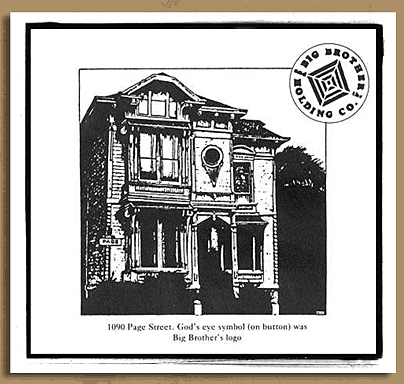
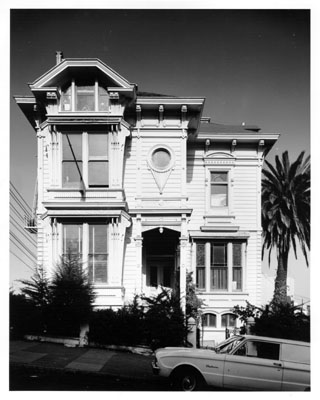
Sometime in the spring or summer of 1964, Rodney Albin’s uncle acquired a twenty-two room Victorian boarding house on the corner of Page and Broderick Streets in San Francisco’s Haight-Ashbury district. The place had seen better days. Built in the 1880s by the owner of a high-toned downtown haberdashery, it had all the modern 1888 conveniences – speaking tubes, a doorbell that rang on each floor, and gas lighting sconces on the walls for when the electricity went out. Its pearl, though, was in the basement: a full-sized ballroom with a stage in one alcove. The entire room was lined with glowing virgin redwood panels.
But in the 1940s, 1090 Page Street was downscaled from a mansion to a boarding house. Life Magazine mentioned it in a 1961 story titled “The Irish in America.” It featured a full-page photo of thirty ‘typical Irish’ working stiffs and Mrs. Minton, their landlady, all leaning out the windows of 1090 Page waving madly.
For Rodney’s uncle, the building was strictly a business investment. He was planning to tear it down and replace it with federally funded senior housing. But the deal was bogged down in Washington somewhere, so Rodney approached him – he knew a way his uncle could make some money on the place while he waited to finalize the deal. Why not rent rooms to San Francisco State students? Why, it happened that Rodney himself was a State student. With his connections he could easily fill the place with the most respectable type of student, earnest and studious. Rodney guaranteed him $600 a month, and was soon installed as landlord of what would become possibly the most renowned proto-hippie/scruffy student pad in San Francisco’s short history. By fall, the place was jumping. Since rooms began at $15 a month, it was affordable, to say the least.
Experimental filmmaker Loren Means lived there during those first few months. “The psychedelic thing and rock and roll hadn’t really happened yet. 1090 was more a community of artists and students. We supported each other and took an interest in what each other were doing. I was in the Film Department at State and also was about to teach a class on Non-Objective Literature at the students’ new Experimental College. I planned to assign Finnegan’s Wake. I was talking to Rodney about it and he said the Wake was a failure. That brought me up short. I’ve never heard anyone else say that about Joyce.”
That was part of the fun of hanging out with Rodney: He would spout that stuff out continually.
Loren told me about another time on campus. “There was some kind of protest going on against the new Student Union because the administration had rejected the architect the students wanted. The protesters started selling hamburgers in competition with the cafeteria. They claimed it was overcharging. Rodney bought hamburgers from both sides and weighed them, and said that the cafeteria hamburgers were a better deal because they weighed a few grams more than the protesters’ hamburgers.”
Dammed iconoclasts, anyway.
Sixties rocker Peter Kraemer told me about the night at 1090 when a critical moment in modern cultural history took place: “Jim Oshita, who used to drive around SF State in a golf cart full of TV sets, supposedly dropped one of those from the top of the great central staircase (he lived up there somewhere); must have been at least five floors down to the ballroom level. This might have been the seminal TV drop; the next one I heard about was in ’66 when The Blues Magoos threw one out an upper window of the Albert Hotel in NY.”
I wonder where Rodney was. He may have been playing his banjo for musical accompaniment. More likely, he wasn’t there. As the landlord, he was supposed to look askance at these irregular and potentially destructive activities.
It’s funny how freaks hated television in those days except, maybe, the Smothers Brothers. Television was the insidious voice of the enemy whispering to America what to buy next. Good riddance!

Rodney, to keep the house full, began renting to people from the local hipster community as well as students. For instance, there was George Shea.
George was an actor. One afternoon, he taped up a poster in the kitchen advertising “Social Realism Tonight — in The Ballroom!” He was working up a one man production of Clifford Odet’s 1930s play Waiting For Lefty. The play, about a taxi drivers’ strike, required actors in the audience to shout out questions and rude remarks to the actors onstage. Since this was a one man show, George had to portray all the characters on stage, then quick hop off the alcove into the ten or fifteen people who’d come down to see the fun, scream an obscenity, then rush back onstage to answer himself. It was a memorable performance, but George’s true fame came a little later.
One morning, George and his girl friend Marilyn woke up bored. So they decided to rob a bank. What the world needed now, clearly, was an Art robbery, a Dada robbery, a Happening robbery. They planned it over a nice cup of Folger’s Instant, then strolled down Divisadero Street to the local Bank of America branch. They had the foresight to scrawl a note that read “Put the money in a bag.” They walked into the bank, waited in line, and when they got to the window, shoved the note through. Of course, they didn’t think they’d actually need a bag. They had other, more interesting plans.
Unfortunately though, we’ll never know what those plans were. The branch had endured a spate of robberies lately, and this morning the teller was a cop. He took one look at the note and pulled his gun.
“Wait! You don’t understand! This isn’t really a robbery. It’s living theater! Help!”
After a couple days in jail, Marilyn’s family paid their bail, hired a lawyer, and eventually got the charge against them reduced to malicious mischief. The story ends even more sadly: the Examiner ran a front page story about the robbery – and spelled George’s name wrong. You just don’t do that to an actor.
Then there was Jones. Jones was a pork pie hatted cool guy who lived in one of the basement rooms off the ballroom. He was older, in his thirties, had fought in Korea, smoked a lot of dope, and, memorably, Jones was a ping pong shark. He never lost! He could have been a champion if they’d had Olympic table tennis in 1965.
“Hey, let’s play some ping pong. Maybe for a nickel…hey, I know, how about twenty-five cents?”
“I don’t really feel like playing tonight, Jones”
“Aw, c’mon, man – I need the exercise. But we have to have to play for something here. How ’bout fifty cents?”
Then, if the unsuspecting resident gave in, Jones would ram ball after ball down his throat. After a while, everybody knew Jones was invincible. But somehow he would manage to wheedle them into one more game.
What did it feel like to be a vet in your thirties surrounded by kids from an entirely different background? Big Brother and The Holding Company’s Peter Albin lived at 1090 Page in Jones’ time. He told me Jones was a kind of big brother himself to the younger, less experienced kids. He taught them how to not get mugged when they were out on the streets late. How not to get rousted when they were holding. How not to get rousted at all if possible. We needed guys like Jones. We didn’t all grow up on the mean outskirts of the Fillmore District, but now we were there.
Next door to Jones lived a big girl from Eureka. She found a good way to make a living but she wouldn’t tell anybody what it was. Arlene (we’ll call her) would eat dinner in the ballroom with everybody else, then put on a nice dress, say “Well, I’ll see you guys later…” and head out. Where did she go? It was a subject that entertained people for weeks until one night she came back to the house in tears. She’d been busted! For hooking! She had to pay a fine. Turned out crime paid, but it was against the law. Who knew? That was the end of her prostitution career.
1090, in spite of contemporary rumors, was never a crash pad. Street people found snoozing in the bathtub were shown the door, forcefully if necessary. One morning Peter Albin got up and headed for the bathroom. There he found a scuzzy-looking stranger sleeping in the bath.
” Hey! Wake up! You can’t sleep here.”
“Huh? Whadayamean? Allen Ginsberg told me it was okay!”
As if that clinched the deal. Somehow Ginsberg had gotten the idea 1090 was open housing for poets and street people who came his way and was sending them to 1090 find a snoozing corner. It probably was quite a helpful stratagem for Allen, but it completely ignored the facts. Bathtub sleeping accommodations were not available at 1090 for complete strangers.
Part of the issue, aside from the fact they might be creeps, was – Rodney had to come up with $600 every month. Besides freeloaders, from time to time he found himself in conflict with deadbeats.
Peter told me about one time his brother had to get serious. “Somebody in the house stole my Martin 000-18. It was a beautiful pre-war guitar. We suspected a guy on the third floor had grabbed it and sold it to buy drugs. He was a deadbeat, hadn’t paid his rent in months, was stoned all the time, and, small problem, he carried a knife.
“Finally, my brother went upstairs and literally kicked the door down. I don’t where he got it – but Rodney borrowed a rifle somewhere, pointed it at the guy and told him to get out of the house right now. He obeyed quite meekly, he was so stoned some people had to help him down the stairs.”

Rodney Waiting By The Door. 1090 Page Street. 1965.
One night in, I guess, early ’65, I walked over to 1090 to see what Rodney was up to. I found him in the big front room with Skip Henderson, a folksinger I knew slightly from State, and three or four other folksingers I’d seen around. They were practicing to sound just like the Limelighters, an energetic and hugely successful folk group of the day. Rodney was tired of being a scruffy old-timey musician. He and Skip and the rest of the hopefuls were jumping on the bandwagon to fame and fortune.
They called themselves the New Tradition Singers. Rodney was singing in his usual thin, nasally voice and playing fiddle and banjo. Actually, I despised the Limelighters – they sounded like a group you might hear at a Barry Goldwater rally — but I admired the New Tradition Singers’ dead-on commercial instincts. Why not cash in? What could go wrong? And tonight they were extra excited. Somehow they had scored a demo tape of Bob Dylan doing his new song Quinn the Eskimo. Bobby had decided not to record it. It was being shopped around to other groups. Could they do something with it?
They sniffed it long. A successful Bob Dylan cover would be a feather in their cap right at the beginning of their career. Look what it had done for The Turtles! You couldn’t get bigger than The Turtles! But, darn it, the song just wasn’t “Drill Ye Terriers, Drill!” (This was a popular folk song about fierce fox terriers. The lead fox terrier is urging the others to dig their way out of a dog show.) It wasn’t “This Land Is Your Land'” either. Or any of the other crowd-pleasers the Limelighters were known for. It was Quinn The Eskimo! It was about an Eskimo who would make you jump for joy when he got here. No, this won’t play well in Peoria. They wouldn’t know what we were singing about. Neither do we. Sorry. We pass.
It was a group decision and normally Rodney would have been unhappy, because he liked the song. But at the moment there was something even more exciting in hand. They had suddenly obtained an agent. Somehow the agent had heard their demo tape and decided they really were going to be the next Limelighters.
And amazingly, she was able to book these unknowns onto baritone John Raitt’s upcoming concert tour, purely on the basis of their demo tape. This agent must be good! They got down to serious rehearsing. They not only practiced the songs, they practiced their banter, they practiced jokes and they practiced comments to the ‘critics’ in the audience.
Loren Means told me about one night when he was alone in the house. “Around midnight the phone started ringing. It must have rang thirty times. I knew it wasn’t for me but I finally forced myself to get up and answer it. Turned out it the woman who was their supposed agent. She had to speak to Rodney right away! I told her Rodney wasn’t there and she just flipped. Eventually it turned out the woman was insane. John Raitt had never heard of her — or them.”
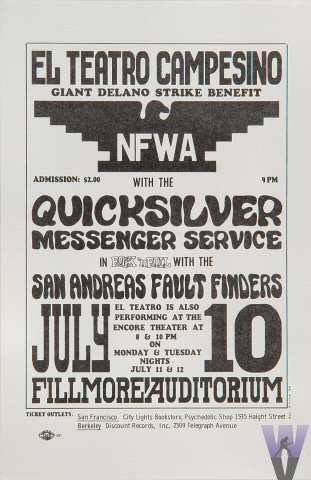
Meanwhile, jamming in the ballroom was becoming a regular ad hoc activity. For one thing a pretty good jug band named the San Andreas Faultfinders was practicing there and they attracted other players, including Pigpen McKernan.
Loren decided to hold a premiere screening of his new experimental film in the ballroom. He invited a lot of people besides the 1090 regulars, and it was going to be a big night. Jack Welpott, a well-known photographer from the SF State Art faculty said he’d come, and – very cool – artist and fellow filmmaker Bruce Conner said he was coming. Conner’s star was high at the moment, so Loren and Peter – who knew who he was – were pretty jazzed. Loren spent the afternoon setting up his 8mm projector and getting the details right. It would be interesting to see the film, if it still exists, because in a way it was the seed for Big Brother and the Holding Company. Loren had cut together an ancient short subject (He described it to me as about ‘a chimp who saves a child from drowning’.) with footage from a nudie film he’d bought in one of those sleaze stores on Market Street. I think you had to be there.
Peter suggested it would be cool if the film had live musical accompaniment. That sounded like a good idea to Loren. Chuck Jones, a surfing style drummer who lived at 1090, already had his drums set up, so Peter grabbed his new electric bass, then called his friend Sam Andrew, who lived a block away. When Sam got there, they both plugged into brother Rodney’s Gibson amplifier, the only one in the house, and fiddled around with Chuck for a while. Then they were ready.
Funny to think. As the three improvised to the flickering images, the spirit of Janis Joplin might have been seen by one of those psychic kind of people. She was whispering very loudly, “Go, you guys! I’ll see you next year.”
That night Chuck became the so far unnamed Big Brother’s first drummer. And it was the earliest rumbling of the partnership between Peter and Sam, which has endured, by my count, some forty-four years. They still tour today.
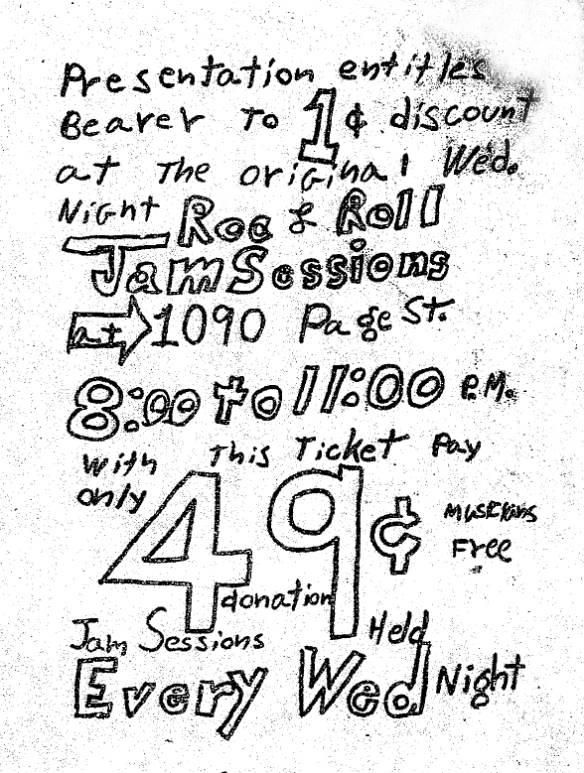
Calligraphy by R. Albin
According to Chet Helms, a hippie named Chris Newton had the idea to formalize the jams, and make them a weekly event. The Wednesday Night Jam Sessions. Charge a quarter. (Jones said, “How ’bout fifty cents?”) Put up signs. Invite everybody.
Chris was good at ideas but, typical hippie, terrible at follow-through – so Chet ran with it. Rodney drew up the 49-cent discount coupon on a ditto master. Chet ran it off, and handed it out down Haight Street. Sam, Peter and Chuck became the house band. If you were a singer or a harp player, they would back you up. If you had your own guitar, you could plug into their amplifier. If you were a singer, you’d better be a shouter, because no one owned a microphone, and if you brought your own, you’d have to plug it into the same amplifier the guitar and the bass were already overdriving.
In the summer of 1965 the Warlocks (soon to be Grateful Dead) were based in Palo Alto. The Jefferson Airplane was already playing every night at their house club, The Matrix. The Charlatans had gone to Virginia City for the summer. But the other musicians who would create the anti-commercial, improvisatory San Francisco Sound were showing up at the 1090 Page Jam Sessions.
The music got so hot in fact that Chet risked raising admission to seventy-five cents. And the hippies kept coming.
It was fun, but it was short. Teenagers from the Avenues crashed the parties, they got rowdy, they tried to start fights with the longhairs, they broke beer bottles on the sidewalk. It got to be a drag. Chet began looking around for the next big thing.
Chuck, Peter and Sam decided to form a real band. Chet Helms was looking for the next big thing and, he decided, it just might be managing this exciting new rock band, soon to change their name to Big Brother And The Holding Company.
Chet brought a couple of interesting contacts along with him. First, he knew a very interesting, self-taught, and slightly bizarre lead guitar player named Jim Gurley. Local legend had it Gurley had taught himself by locking himself into his room and learning John Coltrane solos off a record. He sounded like he had, anyway. Second, Chet knew Bill Graham, and Graham agreed to help them buy equipment. He cosigned the loan.
They went back to practicing in the ballroom, except now they had two really big, really cheap Danelectro amplifiers. Peter hated those amps. “We bought Danelectros because The Great Society had them, and we wanted to be just like the Great Society. But they had stupid little heads that kept falling over. What a pain they were. My bass and one mike went through the first amp. The guitars and the other mike went through the other. We weren’t getting many jobs yet, but we were practicing a whole lot.”
Rehearsal with the two Danelectros was now twice as loud as before. After a few weeks of this, Rodney had enough. “One night we were so loud Rodney got pissed off,” Peter said. “He came down to the ballroom in his shorts and a tank top with a Superman logo on the front. He was waving a pistol.
‘You guys are so fucking loud! You better stop now or I’m going to kill you all!’
‘But Rodney, we’re just playing music’
‘You call that music? I call it driving me insane!”
After he stomped back upstairs, we all just looked at each other. We had to find a new place to rehearse.”

Had all this time Rodney (gasp) secretly disliked screechy rock music played over cheap amplifiers by guys who were still figuring out how to do it?
Peter Kraemer of another early San Francisco Sound band, The Sopwith Camel, had this to say. “He (Rodney) was one of our earliest players, I think he was playing bass but we had dreams of him playing hot viola. He was a wonderful guy and great player, and had either fear or loathing (or both) of rock and roll. He also said he had an ulcer and wouldn’t consider going “on the road”. We of course being younger and brash were raring to go.” So they ended up with a young Londoner named Martin Beard on bass. And Rodney went back to playing folk music.
Looking back on it now, it seems Rodney’s establishment of 1090 Page Street created a center of gravity for the underground that had been missing since they were priced out of North Beach years before, and re-established it in the Haight-Ashbury. Until then, the hippies had lived scattered across cheap neighborhoods of the city – the Fillmore, the Mission, Potrero Hill, Bernal Heights. But once 1090 was in place, the kids who would live out that foolish, divine vision a psychedelic Aquarian Age – and the music that went with it – began to congregate within walking distance of each other.
Take The Pondering Pig for example. In the Fall of ’64 I was looking for a place to live. I dropped in to see Rodney. He told me 1090 was full at the moment, but he knew a guy named Allen Cohen who had a flat six or seven blocks further up Page Street. He thought Allen had a room available, try over there.
Allen did, I moved in, and, I was ‘in’ in a much bigger way – as one of the first denizens of the burgeoning Haight-Ashbury, I would take part in its wondering adolescence, its creative full bloom, and its untimely demise.
There’s a lot more to 1090 Page Street’s story, but I won’t tell it here. The house followed the arc of the neighborhood. It climbed higher and higher, but then, its descent was brutal. By the last days of the Summer of Love – only a few bricks in a vacant lot showed where the famous building had stood.
Graphics credits: 1090 God’s Eye: Dennis Nolan; El Teatro Campesino poster: Wolfgang’s Vault; jam session ticket: Pigfiles; Photo Rodney in the doorway Peter Albin; Photo pre-Janis Big Brother and the Holding Company © 2008 Michael Rachoff; photo 1090 Page St. SF Pub Library.


.JPG)




 ponderingpig.wordpress.com